


INVESTIGATION SKILLS
The Pointy End of Workplace Investigations: Making Findings & Report Writing
Learn how to weigh finely balanced evidence, avoid sitting on the fence, and deliver findings that are impartial, well-reasoned, and legally sound.
- Designed and taught by experts in the field with extensive investigative experience
- Immersive, interactive and practical training with your industry peers
- Access to best practice investigation templates
Let us help you navigate the complexities of weighing evidence and report writing.
Conducting Sexual Harassment Workplace Investigations
$995+GST
Workshop details and booking
By the end of this 2 x 1/2 day workshop, you’ll know how to conduct a fair and legally sound sexual harassment workplace investigation.
* Can’t see a workshop date that suits? Contact us to register your interest in an alternative time or location.
Conducting a Sexual Harassment Workplace Investigation
$995+GST
Workshop details and booking
Register your interest
PUBLIC WORKSHOP
The Pointy End of Workplace Investigations: Making Findings & Report Writing
$595+GST
By the end of this three-hour workshop, you will understand how to structure reports to ensure clarity and demonstrate procedural fairness and analyse evidence in your writing rather than simply repeating it.
BOOK NOW
Select your preferred delivery mode and date:
Or, for a workshop experience tailored to your organisation, learn more about our Tailored Training service.
Online | 3-hour, small-group immersive session
9am – 12pm (AEST)
When the evidence gathering stage concludes, the most critical—and often most challenging—stage begins: making findings and writing a clear, defensible report. This workshop equips Investigators with the skills to weigh finely balanced evidence, avoid sitting on the fence, and deliver findings that are impartial, well-reasoned, and legally sound.
What You’ll Learn
This immersive session blends legal principles with practical techniques for decision-making and report writing. You’ll step into the shoes of an investigator with a case study and evidence to hone your skills. You’ll learn how to confidently reach a decision and move beyond summarising evidence to analysing it, and how to write reports that are neutral, person-centred, and trauma-informed.
Workshop Highlights
- Learning Objectives
- Understand why your job is to make a decision—not to defer or dilute findings—and how to do so with confidence
- Staying impartial and recognising unconscious bias
- Structuring reports to ensure clarity and demonstrate procedural fairness
- How to analyse evidence in your writing rather than simply repeating it
- Using neutral, unbiased, and trauma-informed language
- Practical Application
- Work through a case study where you will:
- Weigh conflicting evidence and make findings
- Learn how to use precise, professional investigator language to clearly demonstrate your reasoning—showing why certain evidence was given more weight and why some accounts were preferred over others
- Draft a section of a report that demonstrates analysis, not just summary of the evidence
- Apply best-practice principles for tone, neutrality, and person-centred writing
- Be provided with a template report
Interactive & Practical
This is not a lecture. It’s a hands-on, scenario-based workshop led by experienced Q Workplace Solutions investigators. You’ll leave with practical tools and confidence to tackle the most complex part of any investigation.
Register Now
Spots are limited to ensure a highly interactive experience. Book your place here.
For group bookings or enquiries, contact 1300 944 049.
“Thank you for the Masterclass on conducting effective investigations. I enjoyed the delivery and content, feeling better equipped to handle an investigation more thoughtfully. The tools and tips you provided will go a long way to helping me prepare when a situation next arises."
Deputy Director Human Resources - (Tertiary Education Sector)
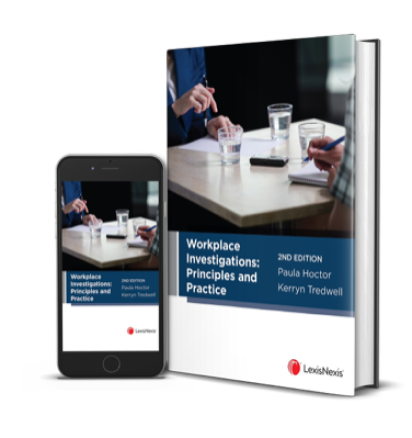
Workplace Investigations: Principles and Practice
Own the essential guide for HR professionals, employment lawyers and workplace investigators. Edited by Paula Hoctor and Kerryn Treadwell.
